|
|
Adelaide HillsSouth Australia

|
Zilzie
|
|
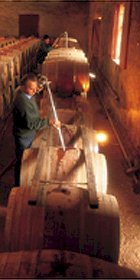
Yalumba, Australia's oldest family owned and operated winery, has a wealth of history and tradition
Yalumba was founded in 1849 by Samuel Smith, British migrant and English brewer, who had brought his family to Angaston seeking a new life. After purchasing a 30-acre parcel of land just beyond the southern-eastern boundary of Angaston, Smith and his son began planting the first vines by moonlight. Samuel named his patch Yalumba, aboriginal for 'all the land around'.
|

|
Woop Woop is Australian slang for the middle of nowhere in the Outback... just been to Woop Woop and back
The Galvanized Wine Group are a collective of people with passion and brands with presence, a grouping which brings together Australian wines crafted at McLaren Vintners by the talented winemaker, Ben Riggs, with owners, managers, staff and stakeholders in common. Woop Woop is a collaboration between intrepid winemaker Ben Riggs and vigneron Tony Parkinson, proprietor of runaway success Penny's Hill. The range includes wines under Mr Riggs own label label - "making the wines I love" - from the Riggs family's Piebald Gully Vineyard and only from other plots considered to be outstanding. Penny's Hill, proudly Australian, more so McLaren Vale from its own high performance McLaren Valley Vineyards.
|
|
The Wolf Blass winery is located at the epicentre of the Australian wine industry, the Barossa Valley and has produced some of Australia's finest wines since 1966
Wolf Blass Wines International was born in 1973 when Wolf started his own business, purchasing a 2.5 acre land holding with an old army shed outside Nuriootpa, at the northern end of the Barossa Valley. John Glaetzer joined the company and from 1974-1976 Wolf Blass Wines won three consecutive Jimmy Watson Trophies, the Black Label generated substantial publicity and hype. From this time onwards growth was impressive with Wolf Blass Yellow Label and Riesling becoming Australia's top selling red and white wine.
|
|
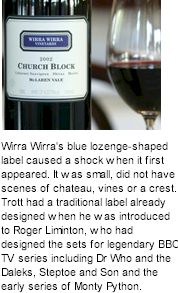
The Wirra Wirra Cellars were built by Robert Strangways Wigley, one of the McLaren Vale's all time characters
Wigley began building at the turn of the century using Dr. A.C. Kelly's plans of a split-level design that his friend Alec Johnston had used to build the Pirramimma winery. Wirra Wirra is an aboriginal name meaning amongst the gums. Born in 1864, Bob Wigley studied Law and Architecture and managed to play cricket for South Australia. His wild pranks as a young man had already made him somewhat of an embarrassment to his family. In 1893 he was prudently sent to rusticate in McLaren Vale. He planted the vineyard in 1894 and made his first wine with Alec Johnston in 1897. By 1901 he was the owner of one of the best wineries and vineyards in the district with 100 acres under vines and 15 acres under currants.
|
|
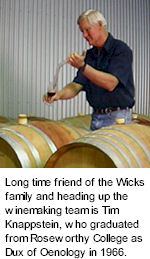
Wicks is a family owned and operated estate vineyard at Woodside in the picturesque Adelaide Hills
The Wicks team are dedicated to producing high quality estate grown wines of exceptional regional character which represent excellent value. Tim and Simon Wicks proudly front the Wicks Estate Label, armed with a firm belief in long term success, aim to steer the company into a position where the Wicks Estate Brand is regarded as one of the Adelaide Hill’s finest. The Wicks Family has a long history of involvement in agriculture with the Woodside Vineyard following on from their orchard and nursery operations at Highbury.
|
|
|
Whodunnit
|

|
Inspired by an intense passion for the land, Unico Zelo wines are crafted to showcase the unique sites and soils which Australia and the Adelaide Hills can offer
Being winemakers, Unico Zelo are people who are incredibly passionate about the soil and produce in Australia. It's their contention to showcase products to the rest of the world that embrace Australian native ingredients and pay homage to the custodianship of the indigenous people who maintained the land for thousands of years. Great wines made in styles that are typified by the life and culture of this sunburnt country, from grape varieties that require minimal intervention. It's this passion that has driven Unico Zelo to start two wine labels, one that protects farmers and another that protects the future. They've since taken these concepts, alongside their Applewood Distillery, and catapulted them into the horticultural realm, studying indigenous produce, it's beneficial effects on the land and the stories it can tell through incredible colours, flavours and textures.
|
|
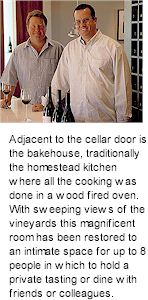
The 'two hands' are Michael Twelftree and Richard Mintz who formed the company in 1999 with the clear objective of making the best possible Shiraz
Michael came to the wine industry from a construction background having spent years attending wine tastings and collecting the wines of the world. In 1998, he established his own Australian wine export company and after three successful years of selling other people's wine, he and business partner Richard Mintz decided to start their own operation.
|
|
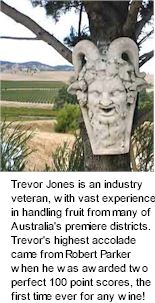
Trevor Jones began his winemaking career in 1977 at Bernkastel before accepting a position as assistant winemaker at Karrawirra Wines in 1979
In 1982 Trevor was appointed head winemaker and remained in that position until 1986. During Trevor's time at Karrawirra he also made wines for Kellermeister. At the end of 1986 Trevor moved to the Upper Hunter Valley, in NSW, to take up employment as winemaker for Tyrrell's Vineyards at their Glenbawn Estate Winery. In 1989 he returned to the Barossa Valley as full time winemaker at Kellermeister. During his time at Kellermeister, Trevor also worked as a consultant for Anglesey and Glenara. Trevor was also employed by St. Hallett as a contract winemaker during eight vintage seasons.
|
|
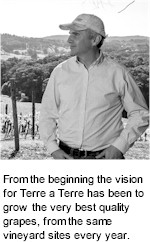
Terre a Terre make wines from the cool climate regions of Adelaide's Piccadilly Valley and Wrattonbully on the Limestone Coast.
Xavier Bizot and Lucy Croser both grew up surrounded by passionate winemaking families. In 2005 they launched their boutique wine import business, Terroir Selections. Together they unearthed small, terroir domaines from Europe for importation to Australia. Inspired by the wines they discovered, they purchased a special piece of land in Wrattonbully and planted their first vineyard. From the beginning the vision for Terre à Terre has been to grow the very best quality grapes, from the same vineyard sites every year, and then vinify them using the best of French and Australian wine practices. In addition to Terre à Terre, the couple also grow and make traditional method sparkling wine under the name DAOSA (Dedicated Artisans of South Australia), from their sparkling Chardonnay and Pinot Noir vineyards in Piccadilly Valley.
|
|
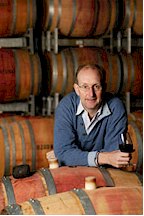
Situated at the very heart of South Australia’s beautiful Clare Valley, Taylors has become one of Australia’s best loved and most trusted wineries
The tale of Taylors winemaking goes back a few years – three generations in fact, and all began with Bill Taylor Senior, and his love of a certain Bordeaux wine. Originally wine merchants in Sydney, a passion for wine was all part of being a Taylor, and in particular, for the famous French Clarets such as Chateau Mouton Rothschild in Bordeaux’s Medoc region. It was this long held fascination for these wines which inspired the family’s foray into winemaking, and provides the inspiration and winemaking philosophy behind all Taylors winemaking today – to produce premium wines of exceptional and comparable quality in Australia.
|
|
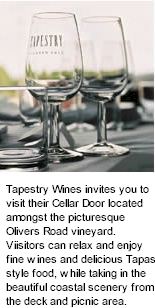
Situated right in the heart of the McLaren Vale, Tapestry's rich ironstone soils and cool coastal climate provide ideal conditions for producing well structured and richly flavoured wines of exceptional quality
Surrounded by undulating hills and with the waters of the Gulf of St Vincent sparkling in the distance, the view from Tapestry Wines is both relaxing and therapeutic the perfect environment for the discerning wine drinker or your next special function. Estate grown vines are the major source of fruit. The vines span two vineyards within the McLaren Vale Wine Region. Both vineyards are very low yielding and produce fruit and wines with intense flavour and concentration. Tapestry's commitment to quality has seen this relatively small boutique label receive a number of awards and go on to establish export markets everywhere.
|
|
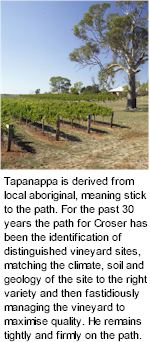
Even as the ink was drying on the Petaluma purchase in 2001, Brian Croser's friends at Champagne Bollinger were forming a pact with the Croser family to begin again
Then along came the Cazes family from Chateau Lynch Bages in Pauillac. On a trip to Australia in 2002, Jean-Michel and his son Jean-Charles met with Croser and joined the partnership. The driving ambition was to own and make wine from the more than 30-year old Koppamurra Vineyard just north of Coonawarra. Tapanappa was born and Koppamurra Vineyard was acquired in late 2002. The property has since been renamed Whalebone Vineyard. The partnership was founded in a strong, mutually held belief that some pieces of ground are much better than others for the production of fine wine. Of course this superiority is highly specific to varieties and wine style. The Whalebone Vineyard and Cabernet Sauvignon in particular have a unique synergy. Croser learned of the wonderful quality of Cabernet from the Whalebone Vineyard 25 years ago when in 1980, he assisted Geoff Weaver to make his very first wine from this vineyard under the Ashbourne label.
|
|
Unlike many wineries, the history of Starvedog Lane isn’t linked to some long dead legendary winemaker who was the son of someone rich or famous
There are no tales of bravery and courage, and no triumph of the pioneering human spirit. Of suffering and loss, but ultimate victory in the face of adversity all in the interest of bringing you a great drop of wine. Nope. Just a name that comes from some old story about a hungry dog and some German settlers and a bunch of winemakers who are pretty fanatical about what they do. So what Starvedog Lane lack in a colourful and eventful history, they more than make up for with some sensational wines. And at the end of the day, that’s what it’s all about, right?
|
|
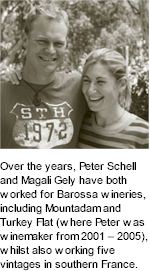
Spinifex is a small family owned and operated winery established in 2001 by Peter Schell and Magali Gely
Spinifex make small quantities of unique hand crafted regional wines from the Barossa and Eden Valleys. Spinifex are typically blended, as a more complete and complex, unique and characterful wine can be assembled from components that are the result of the interaction between variety, soil and meso-climate. Peter Schell makes all the wines at the estate winery in Bethany, Tanunda, where he also runs his own winemaking consultancy company. Over the years, the pair have both worked for Barossa wineries, including Mountadam and Turkey Flat (where Peter was winemaker from 2001 – 2005), whilst also working five vintages in the South of France. In 2001 Peter and Magali decided to start making their own wines, sourcing grapes from five old Barossa vineyards to complete about 400 cases in that first year.
|
|
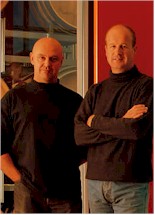
Shaw + Smith began over a long lunch in 1989 when cousins Martin Shaw and Michael Hill Smith decided to realise a long held dream to make wine together
Shaw + Smith's aim is to make contemporary, high quality wines that stand amongst the best of their type, both nationally and internationally. For a wine to be released under the Shaw + Smith label it must be an oustanding example of it's type, from grapes grown in the Adelaide Hills. For the first ten years Shaw + Smith focussed on Sauvignon Blanc and Chardonnay, and now also make small quantities of Riesling, Pinot Noir and Shiraz. White varieties are well suited to the cooler climate of the Adelaide Hills, while Pinot Noir and Shiraz perform well in carefully chosen sites.
|
|
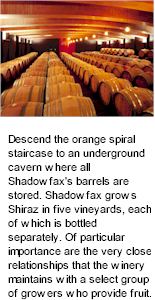
Shadowfax creates outstanding and pure regional wines, from excellent fruit grown to superior vineyards scattered around some of Victoria's most precious grapegrowing districts
Shadowfax grows Shiraz in five vineyards, each of which is bottled separately. These five vineyards are maintained by dedicated vignerons under the direction of the very talented Chief Winemaker. Of particular importance are the very close relationships that the winery maintains with a select group of growers who provide fruit for the Chardonnay, Sauvignon Blanc, Pinot Gris and Pinot Noir.
|
|
|
The Seabrook Family have been part of the Australian wine business since 1878, starting one of the country’s most respected wine companies W.J Seabrook & Son
Seabrook Wines is an artisan winemaker who works with growers to source exceptional fruit from the top regions around Australia and make premium wine to sell both domestically and into the international market. The business is family owned and operated out of the Barossa Valley where their estate vineyard and winery is located at the base of Menglers Hill in Tanunda. Since their first vintage in 2005 Seabrook wines have been awarded Haliday’s 5 star rating for the winery as well as several wine show medals.
|
|
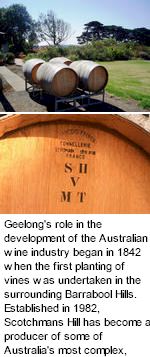
Scotchmans Hill is a family owned vineyard and winery based on the Bellarine Peninsula in Victoria, Australia
Established in 1982, Scotchmans Hill has become a producer of some of Australia's most complex, elegant and consistent wines. Scotchmans Hill is located on Mount Bellarine which was named by the Scottish immigrants who settled the Mount Bellarine area in the 1840s. Mount Bellarine was formed over 30 million years ago by tectonic movement which formed Port Phillip Bay and the surrounding volcanic region of Geelong and Mount Bellarine.
|
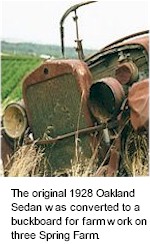
|
In 1866 the Schild Family immigrated to Australia from Poland as part of the exodus from religious persecution
Johannes Hugo Bernhard (Ben) Schild, the father of Edgar (Ed) Schild heeded the work of his ancestors thus ensuring that the Schild family would have an impact in this new country. Ben Schild met his wife Freida Alma Schild nee Schutz in the early 1920s and began a family which consisted of eight children raised in the wilds of the Mallee country near the small pioneering town of Lameroo.
|

|
Stephen Pannell is one of the nation's most decorated winemakers, he makes wine that's designed to accompany the Australian way of life, wines that drink well alongside the opulent menu of ingredients and cuisines which are
on offer in the land downun
SC Pannell is a small, family owned and operated winery, established 2004 by Stephen Pannell and wife Fiona Lindquist. The winery was founded to focus on Stephen's passion for McLaren Vale and its ability to produce dry grown, environmentally sustainable Shiraz and Grenache. In his capacity as Chief Red Wine Maker at BRL Hardy, Pannell gained an intimate knowledge of the region’s vineyards and sub-regional variations, he was able to secure exquisite parcels of old vine Grenache and Shiraz from low yielding, dry grown sites. He wanted to make wines from the region that express their sense of place and define the character and expression of McLaren Vale.
|
|
|
Sarantos is where you’d rather be
Sarantos is that amazing place - or fantastic state of mind - where everything’s relaxed, and full of fun, good friends, good food and good wine. It’s that place – or feeling you have - when only Sarantos will do. When you want a soft pressed wine that’s so gorgeously slurpable, to be enjoyed al fresco, at friends or in your favourite café or restaurant. Sarantos do everything in the Sarantos-style. Refreshingly relaxed, down to earth and with a great passion for sharing good wine and good food with great friends.
|
|
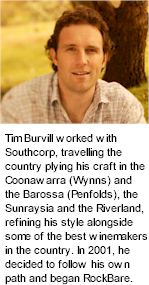
RockBare was born out of Tim Burvill's desire to create his own wine from fruit grown to Australia's best viticultural regions
Growing up in Western Australia, Tim's interest in wine was sparked at a young age by frequent summer holidays to the Margaret River region. He fell in love with the world of wine, his passion eventually saw him move to South Australia, where he completed an honours degree at Adelaide University's Roseworthy Campus. His first job was with Southcorp, which as Tim puts it "was the best start to a winemaking career that anyone could ask for." For the next 5 years Tim worked with Southcorp, travelling the country plying his craft in the Coonawarra (Wynns) and the Barossa Valley (Penfolds), the Sunraysia and the Riverland, refining his style alongside some of the best winemakers in the country. A rapid rise through the ranks soon saw him vested with the responsibility at the age of 25, of making Southcorp's ultra-premium white wines, including Penfolds Yattarna. In 2001, Tim decided to follow his own path and began RockBare, focusing on Chardonnay and Shiraz from South Australia's McLaren Vale.
|
|
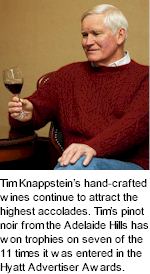
After a decade of confusion about his distinguished history and name, which continues as a famous Clare Valley that he founded in the 1970s, Tim Knappstein made the decision to launch a new label in 2006
The name chosen was Riposte, for which the dictionary definition is comeback, a quick reply, retort, or in the context of the sport of fencing a quick counter stroke. The wines, sourced from selected premium vineyards in South Australia’s cool climate Adelaide Hills, carry sword names reflecting the fencing theme. They display the pure varietal characters of this exceptional cooler region. The aim of Riposte is to deliver top quality wines at affordable prices aided by meticulous winemaking, rigourous grape selection and Tim’s 40 years of winemaking and judging experience. Tim Knappstein stands tall among Australia’s elite winemakers, a third generation vigneron with 40 years experience producing wines of finesse and excellence.
|
|
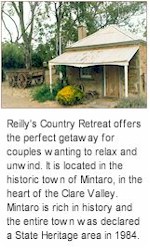
In 1856 an Irish cobler by the name of Hugh Reilly arrived at the tiny township of Mintaro in the Clare Valley
Over the next 10 years, Hugh converted the stone barn that had been his home into a cottage. Reilly's Cottage served as the local Cobbler's Shop in the centre of the bustling town, which had boomed with the discovery of slate in the area. Almost 140 years later, the cottage has been restored to its former glory by distant relatives of Hugh, the Ardill family, and once again it is a hive of activity, and home to Reilly's Wines.
|

|
Primo Grilli planted his vineyard in 1973 a a spot 30 kilometres north of Adelaide within the rich fertile market gardening land of Virginia
Only 3 kilometres from the coast, Virginia enjoys the benefits of the cool sea breezes that sweep over the plains in the evenings. Primo built his vineyard with passion and understood completely the life of a vine. The grapes were grown to be turned into wine. His eldest son Joseph grew up with the vines tending them with the rest of the family. Joseph was to be a winemaker. It was not a conscious choice, not an expectation, just a progression, what he had to be. From his very first vintage, at age 20, Primo Estate's Joe Grilli wanted to create revolutionary wines. Ever since, Joe has been doing exactly that; creating some wonderfully dazzling and unconventional wines under the Joseph and Primo Estate labels.
|
|
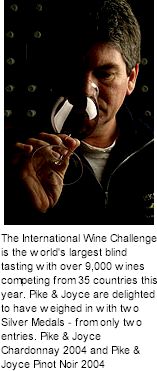
The Pike & Joyce brand represents the coming together of two long time South Australian families to form a partnership in wine
The Pikes, long established in winemaking and viticulture, and the Joyce, longtime horticulturists, have come together to develop this 18ha joint venture vineyard at Lenswood in the Adelaide Hills. The vineyard site, which was once apple and pear orchards, is characterized by steep North and East facing slopes and possesses fantastic gravelly clay and loam soils which are ideally suited to the classic cool climate varieties that have been planted – Sauvignon Blanc, Pinot Gris, Chardonnay and Pinot Noir.
|
|
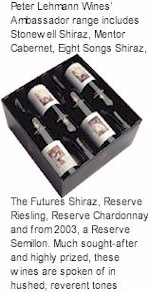
Since its inception in 1979, Peter Lehmann Wines has emerged as one of Australia's most respected, energetic and innovative wine producers
All operations are carried out on a single site located near Tanunda, in the heart of the internationally famous Barossa Valley, South Australia. Peter Lehmann Wines has earned many medals and trophies along with great accolades from wine judges in Australia and throughout the world. Now a public company of international repute, Peter Lehmann Wines is regarded as one of Australia's pre-eminent wine brands.
|
|
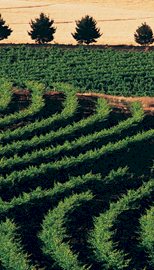
Established by Brian Croser in 1976, Petaluma is one of Australia's most prominent wine companies.
The pre-eminent quality of Petaluma's wines is based on distinguished vineyard sites for each of the chosen varieties, in four important South Australian wine regions - Piccadilly Valley in the Adelaide Hills, for Pinot Noir and Chardonnay - Mount Barker in the Adelaide Hills, for the Rhone varieties Viognier and Shiraz - Clare Valley, for Riesling and - Coonawarra, for Cabernet Sauvignon and Merlot
|
|
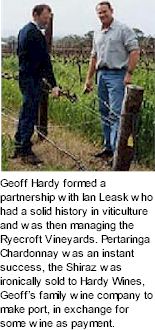
The vineyards around the foothills behind McLaren Vale have always produced some of the regions finest wines, the enriched soils and sea breezes off St Vincent’s Gulf, set the scene for high quality wine grapes
In 1981 the Australian Wine Industry was in bad shape. Classic old vines, used to make fortified and red wines, were being removed. Big companies were pulling out of the industry. Twenty four year old Geoff Hardy had recently graduated from Roseworthy Agricultural College and had seen how the Californians were grafting old vines over to new varieties such as Chardonnay. Geoff formed a partnership with Ian Leask who already had a solid history in viticulture and was then managing the Ryecroft Vineyards. The vineyard was available for sale and this is how Pertaringa, an Aboriginal name meaning Belonging to the Hills, was born.
|
|
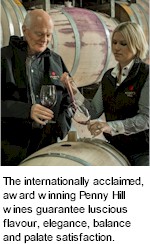
Penny's Hill is are renowned for their distinctive red dot packaging and overwhelming critical acclaim ever since the inaugural 1995 vintage
Penny's Hill remain committed to producing the very finest fruit from their superlative estate vineyards, the superior Penny's Hill site, Goss Corner and Malpas Road properties. Penny's Hill are housed at Ingleburne, originally owned by Thomas Overton who farmed the land and established a Dernier school on the property in 1848. Ingleburne was established by Thomas Goss who leased and later purchased the property in 1854. Goss had the good fortune to return from the Victorian goldfields some fifteen hundred pounds for the better. No doubt this enabled him to build the double storied residence, so long a landmark on the way south from McLaren Vale to Willunga.
|
|
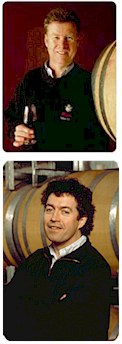
Penfolds was founded by a young English doctor who migrated to one of his country's most distant colonies a century and a half ago
Dr Christopher Rawson Penfold was born in 1811, the youngest of 11 children. He studied medicine at St Bartholomew's Hospital, London, graduating in 1838. Like many doctors before and since, Dr Penfold had a firm belief in the medicinal value of wine. Before he left Britain he had obtained vine cuttings from the south of France and these were planted around the site of the modest stone cottage he built with his wife, Mary, at Magill on the outskirts of Adelaide in 1845. The couple called this house The Grange, after Mary's home in England.
Adelaide Hills Wines by Penfolds Penfolds Bin 13A Reserve Chardonnay 2013» Adelaide Penfolds Bin 144 Yattarna Chardonnay 1999» Fleurieu Adelaide Penfolds Bin 23 Pinot Noir» Adelaide Penfolds Bin 707 Cabernet 1.5L MAGNUM 2007» Barossa Coonawarra Adelaide Penfolds Bin 707 Cabernet Sauvignon 1993» Coonawarra Padthaway Adelaide Penfolds Bin A Reserve Chardonnay 2007» Adelaide Penfolds Cellar Reserve Sangiovese» Barossa Adelaide Penfolds Grange 1.5L MAGNUM 1995» Barossa McLaren Adelaide Padthaway Penfolds Grange 1.5L MAGNUM 1996» Barossa McLaren Adelaide Padthaway Penfolds Grange 1.5L MAGNUM 2003» Barossa Coonawarra McLaren Adelaide Penfolds Grange 1.5L MAGNUM 2006» Barossa Coonawarra Adelaide Penfolds Grange 1995» Barossa McLaren Adelaide Padthaway Penfolds Grange 1998» Barossa Padthaway Adelaide Penfolds Grange 2003» Barossa Coonawarra McLaren Adelaide Penfolds Grange 2006» Barossa Coonawarra Adelaide Penfolds Grange Hermitage 1.5L MAGNUM 1979» Barossa Adelaide Clare McLaren Penfolds Grange Hermitage 1.5L MAGNUM 1980» Barossa Adelaide Clare McLaren Coonawarra Penfolds Grange Hermitage 1.5L MAGNUM 1981» Barossa Adelaide Penfolds Grange Hermitage 1.5L MAGNUM 1982» Barossa Adelaide Clare Penfolds Grange Hermitage 1.5L MAGNUM 1983» Barossa Adelaide Penfolds Grange Hermitage 1.5L MAGNUM 1984» Barossa Adelaide Clare McLaren Coonawarra Penfolds Grange Hermitage 1.5L MAGNUM 1985» Barossa Adelaide Clare Penfolds Grange Hermitage 1.5L MAGNUM 1986» Barossa Adelaide Clare McLaren Penfolds Grange Hermitage 1953» Adelaide Barossa Penfolds Grange Hermitage 1954» Adelaide Barossa Penfolds Grange Hermitage 1955» Adelaide Barossa McLaren Penfolds Grange Hermitage 1956» Adelaide Barossa Penfolds Grange Hermitage 1957» Adelaide McLaren Penfolds Grange Hermitage 1958» Adelaide Barossa McLaren Penfolds Grange Hermitage 1959» Adelaide Barossa Penfolds Grange Hermitage 1961» Adelaide Barossa Coonawarra Penfolds Grange Hermitage 1962» Barossa Adelaide Penfolds Grange Hermitage 1964» Adelaide Barossa Penfolds Grange Hermitage 1966» Barossa Adelaide Penfolds Grange Hermitage 1969» Barossa Adelaide Clare Coonawarra Penfolds Grange Hermitage 1970» Barossa Adelaide Penfolds Grange Hermitage 1971» Adelaide Barossa Clare Coonawarra Penfolds Grange Hermitage 1972» Barossa Adelaide Coonawarra Penfolds Grange Hermitage 1973» Barossa Adelaide Penfolds Grange Hermitage 1974» Barossa Adelaide Penfolds Grange Hermitage 1976» Barossa Adelaide Penfolds Grange Hermitage 1977» Barossa Adelaide Clare Penfolds Grange Hermitage 1979» Barossa Clare Adelaide McLaren Penfolds Grange Hermitage 1980» Barossa Adelaide Clare McLaren Coonawarra Penfolds Grange Hermitage 1981» Barossa Adelaide Penfolds Grange Hermitage 1982» Barossa Adelaide Clare Penfolds Grange Hermitage 1983» Barossa Adelaide Penfolds Grange Hermitage 1984» Barossa Adelaide Coonawarra McLaren Clare Penfolds Grange Hermitage 1985» Barossa Adelaide Clare Penfolds Grange Hermitage 1986» Barossa Clare McLaren Adelaide Penfolds Grange Hermitage Jimmy Watson 1965» Barossa Adelaide McLaren Penfolds Grange Hermitage Jimmy Watson 1967» Barossa Adelaide Clare Penfolds Magill Estate Shiraz 1.5L MAGNUM 2005» Adelaide Penfolds Magill Estate Shiraz 2003» Adelaide Penfolds Magill Estate Shiraz 2005» Adelaide Penfolds Max Chardonnay» Adelaide Penfolds St Henri 1.5L MAGNUM 2008» Barossa McLaren Langhorne Adelaide Penfolds Thomas Hyland Shiraz 2012» Adelaide
Other Wines by Penfolds Penfolds 76 Seventy Six Shiraz Cabernet» Barossa McLaren Wrattonbully Penfolds Bin 128 Coonawarra Shiraz» Coonawarra Penfolds Bin 128 Coonawarra Shiraz 2005» Coonawarra Penfolds Bin 138 Shiraz Grenache Mourvedre» Barossa Penfolds Bin 144 Yattarna Chardonnay» Penfolds Bin 150 Marananga Shiraz» Barossa Penfolds Bin 170 Kalimna 2010» Barossa Penfolds Bin 2 Shiraz Mataro» Penfolds Bin 28 Kalimna Shiraz» Penfolds Bin 28 Kalimna Shiraz 1990» Penfolds Bin 28 Kalimna Shiraz 2013» Penfolds Bin 311 Tumbarumba Chardonnay» Tumbarumba Penfolds Bin 389» Barossa McLaren Penfolds Bin 389 1.5L MAGNUM 2009» Padthaway Barossa McLaren Coonawarra Wrattonbully Penfolds Bin 389 2003» Barossa McLaren Penfolds Bin 389 2008» Barossa Coonawarra Langhorne McLaren Penfolds Bin 389 2012» Wrattonbully Barossa McLaren Langhorne Robe Penfolds Bin 389 Vintages 2008 2011» Penfolds Bin 407» Penfolds Bin 407 2006» Robe Coonawarra McLaren Vale Langhorne Barossa Penfolds Bin 407 2008» Coonawarra Robe Wrattonbully Padthaway Penfolds Bin 51 Eden Valley Riesling» Eden Valley Penfolds Bin 620 Coonawarra Cabernet Shiraz 2008» Coonawarra Penfolds Bin 707 Cabernet 1.5L MAGNUM 1989» Coonawarra Barossa Penfolds Bin 707 Cabernet 1.5L MAGNUM 1990» Coonawarra Barossa Penfolds Bin 707 Cabernet 1.5L MAGNUM 1991» Coonawarra Barossa Penfolds Bin 707 Cabernet 1.5L MAGNUM 1994» Coonawarra, Barossa & Mount Barker Penfolds Bin 707 Cabernet 1.5L MAGNUM 1997» Coonawarra Bordertown Padthaway Barossa Penfolds Bin 707 Cabernet 1.5L MAGNUM 1998» Coonawarra Padthaway Barossa McLaren Penfolds Bin 707 Cabernet 1.5L MAGNUM 1999» Coonawarra Padthaway Barossa Penfolds Bin 707 Cabernet 1.5L MAGNUM 2001» Coonawarra, Padthaway, McLaren, Barossa Penfolds Bin 707 Cabernet 1.5L MAGNUM 2002» Barossa McLaren Padthaway Penfolds Bin 707 Cabernet 1.5L MAGNUM 2004» Barossa McLaren Coonawarra Penfolds Bin 707 Cabernet 1.5L MAGNUM 2005» Barossa Valley, Coonawarra, Padthaway Penfolds Bin 707 Cabernet 1.5L MAGNUM 2009» Coonawarra Barossa Wrattonbully Padthaway Penfolds Bin 707 Cabernet Sauvignon» Penfolds Bin 707 Cabernet Sauvignon» Coonawarra Padthaway Barossa Penfolds Bin 707 Cabernet Sauvignon 1977» Coonawarra Barossa Penfolds Bin 707 Cabernet Sauvignon 1982» Coonawarra Barossa Penfolds Bin 707 Cabernet Sauvignon 1986» Coonawarra Barossa Penfolds Bin 707 Cabernet Sauvignon 1987» Coonawarra Barossa Penfolds Bin 707 Cabernet Sauvignon 1989» Coonawarra Barossa Penfolds Bin 707 Cabernet Sauvignon 1990» Coonawarra McLaren Barossa Penfolds Bin 707 Cabernet Sauvignon 1991» Coonawarra Barossa Penfolds Bin 707 Cabernet Sauvignon 1992» Coonawarra Barossa Penfolds Bin 707 Cabernet Sauvignon 1994» Coonawarra, Barossa & Mount Barker Penfolds Bin 707 Cabernet Sauvignon 1996» Coonawarra Barossa Padthaway McLaren Penfolds Bin 707 Cabernet Sauvignon 1997» Coonawarra Barossa Penfolds Bin 707 Cabernet Sauvignon 1998» Coonawarra Padthaway Kalimna McLaren Penfolds Bin 8 Cabernet Shiraz» Coonawarra Penfolds Bin 9 Cabernet Sauvignon» McLaren Wrattonbully Coonawarra Penfolds Cellar Reserve Cabernet Sauvignon» Barossa Penfolds Cellar Reserve Cabernet Shiraz 2005» Coonawarra + Barossa Penfolds Cellar Reserve Semillon» Penfolds Cellar Reserve Viognier 375ml» Penfolds Club Tawny Port» Barossa Penfolds Father 10 Years Grand Tawny» Penfolds Grandfather Tawny» Penfolds Grange 1.5L MAGNUM 1990» Barossa Clare Coonawarra Penfolds Grange 1.5L MAGNUM 1991» Barossa McLaren Penfolds Grange 1.5L MAGNUM 1992» Barossa Coonawarra McLaren Penfolds Grange 1.5L MAGNUM 1993» Barossa Coonawarra Penfolds Grange 1.5L MAGNUM 1994» Barossa, McLaren Vale, Coonawarra Penfolds Grange 1.5L MAGNUM 1997» Barossa McLaren Penfolds Grange 1.5L MAGNUM 1999» McLaren Padthaway Barossa Kalimna Penfolds Grange 1.5L MAGNUM 2000» Barossa Penfolds Grange 1.5L MAGNUM 2001» Barossa Penfolds Grange 1.5L MAGNUM 2002» Barossa McLaren Penfolds Grange 1.5L MAGNUM 2004» Barossa McLaren Magill Penfolds Grange 1.5L MAGNUM 2007» Barossa, McLaren & Magill Estate Penfolds Grange 1990» Barossa Clare Coonawarra Penfolds Grange 1991» Barossa McLaren Penfolds Grange 1992» Barossa Coonawarra McLaren Penfolds Grange 1993» Barossa Coonawarra Penfolds Grange 1994» Barossa, McLaren Vale, Coonawarra Penfolds Grange 1996» Barossa McLaren Adelaide Padthaway Penfolds Grange 1997» Barossa McLaren Bordertown Penfolds Grange 1999» Barossa Penfolds Grange 2000» Barossa Penfolds Grange 2001» Barossa Penfolds Grange 2002» Barossa McLaren Penfolds Grange 2004» Barossa McLaren Magill Penfolds Grange 2005» Barossa McLaren Coonawarra Penfolds Grange 2007» Barossa, McLaren & Magill Estate Penfolds Grange 2008» Barossa Clare Magill Penfolds Grange 2009» Barossa McLaren Clare Magill Penfolds Grange 2012» Barossa McLaren Penfolds Grange Hermitage 1.5L MAGNUM 1987» Barossa McLaren Penfolds Grange Hermitage 1.5L MAGNUM 1988» Barossa, Padthaway, McLaren Vale Penfolds Grange Hermitage 1.5L MAGNUM 1989» Barossa McLaren Penfolds Grange Hermitage 1960» Penfolds Grange Hermitage 1975» Barossa Coonawarra Penfolds Grange Hermitage 1987» Barossa McLaren Penfolds Grange Hermitage 1988» Barossa, Padthaway, McLaren Vale Penfolds Grange Hermitage 1989» Barossa McLaren Penfolds Great Grandfather Port» Barossa Penfolds Koonunga Hill Cabernet» Penfolds Koonunga Hill Chardonnay» Penfolds Koonunga Hill Shiraz Cabernet» Penfolds Koonunga Hill Shiraz Cabernet 375ml» Penfolds Max Cabernet Sauvignon» Penfolds Max Pinot Noir» Tasmania Henty Penfolds Max Shiraz» Penfolds Max Shiraz Cabernet» Penfolds RWT Shiraz» Barossa Penfolds RWT Shiraz 1.5L MAGNUM 2003» Barossa Penfolds RWT Shiraz 1.5L MAGNUM 2006» Barossa Penfolds RWT Shiraz 2010» Barossa Penfolds St Henri» Penfolds St Henri 2007» Penfolds St Henri 2010» Barossa Penfolds St Henri 375ml» Barossa Penfolds The Max Schubert Cabernet Shiraz» Penfolds Thomas Hyland Cabernet 2012» Penfolds Tribute Cabernet Sauvignon» Penfolds Tribute Cabernet Shiraz» Penfolds Tribute Shiraz»
|
|
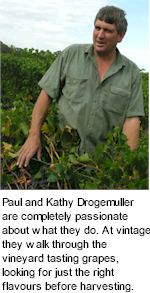
Paracombe is an award winning, family operation gaining recognition in Australia and internationally, producing a distinctive range of wines displaying finesse and varietal intensity
The Paracombe vineyard and winery is located in some of South Australia’s most picturesque countryside, the Adelaide Hills. The surrounding terrain is quite hilly with some parts being very steep, yet our vineyard rests on this exclusive parcel of relatively flat plateau. Paul and Kathy Drogemuller established Paracombe Wines in 1983 following the Ash Wednesday bushfires. The property, a former dairy farm was totally ravaged by the bushfire. Despite the devastation, Paul and Kathy could see great potential as a vineyard site and commenced plantings which has grown to close to 16 hectares today. Together with hard work and vision they designed and built a fully operational winery with facility to crush around 1000 tonnes of fruit.
|
|
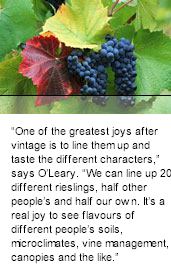
O'Leary Walker Wines is the culmination of two like minded winemakers that met over twenty years ago
Established in 2001 by David O'Leary and Nick Walker, their philosophy is pretty simple, source the best grapes from the best vineyard sites and craft great wine. O'Leary Walker is based at Leasingham in the Clare Valley, South Australia, but they don't limit themselves to producing just Clare Valley wines. O'Leary Walker also source fruit from other premium grape growing districts in South Australia including the Adelaide Hills, Barossa Valley, Coonawarra and McLaren Vale. The theory behind this is to draw on the grape varieties that excel in these quite different viticultural climates.
|
|
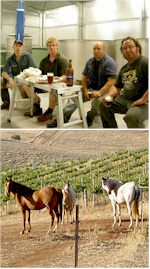
The challenge began when it was decided to fashion hand made wines from precious fruit grown to superlative sites which escaped the vine pull of the 1980s
The Longhop and Old Plains range of wines are produced by Domenic Torzi and Tim Freeland. The former Gawler high school mates first mooted the idea of making icon wines from the Adelaide Plains in 2002. Vineyards were secured, the requirement being old vines a priority. The small band of growers have embraced the ideal of delivering premium grapes in order to showcase the power and rich fruit flavours the Adelaide Plains has to offer.
|
|
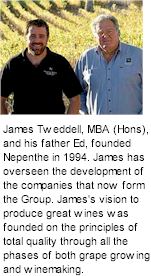
Nepenthe is described by Homer in the Odyssey as an Egyptian herbal drink so powerful that it eases grief and banishes sorrow from the mind
Up in the cool heights of the Adelaide Hills, Nepenthe have been producing some soul reposing potions of their own, uncompromising wines of outstanding quality and internationally recognised distinction. Wines that, strangely enough, have been impressing both critics and consumers with their varietal faithfulness and subtle Adelaide Hills nuances.
|
|
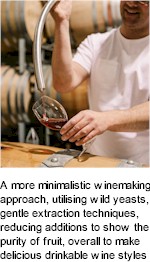
Welcome to Murdoch Hill, so very proud of their patch on Adelaide Hills, so very excited to share it with you
Murdoch Hill acknowledges the people of Peramangk Land on which it stands and recognises their connection to culture, country and community. Murdoch Hills vineyard and winery are located behind the beautiful Adelaide Hills township of Oakbank. Family farmed since 1939, with four generations caring for their land. The great adventure into winemaking began 1998. The winemaking team had already cut their teeth amongst the sacred vineyards of Barolo, the illustrious Shaw & Smith and Best’s Great Western. They returned to Murdoch Hill to make wines that are fully focused on being honest to their origins and to express local creativity. Combining sound technical knowledge with an adventurous spirit. Employing techniques which give freshness and vibrancy, achieving elegant wines that are best suited to pairing alongside the modern Australian food scene.
|

|
And, yes.. Ben does have a vineyard
Located at Kangarilla on the edge of the McLaren Vale designated region, Piebald Gully is a recently planted patch producing fine grade Shiraz, Viognier and Petit Verdot from low yielding hand tended vines. Besides 22 vintages in Australia, Ben has presided over a further eight overseas. Experience has been gained in the Napa Valley, Bordeaux, Greece, Italy and the South of France which gives Ben a broad appreciation of wine styles and winemaking practices. A graduate of Roseworthy (in 1985), Ben has made a major contribution to regional wine industry activities having served 10 years as a board member of McLaren Vale Winemakers Inc. Three of those years saw Ben in the role of Chairman. He also chaired the McLaren Vale Wine Show over a 5-year period. Wines made by Ben have achieved considerable Wine Show Awards success including winning the first two Great Australian Shiraz Challenges. More than 20 trophies have been won and in 1993, Wirra Wirra 1991 Angelus was declared the winner of the Sydney International Top 100 wine awards.
|

|
Mike Press Wines are located in the internationally acclaimed Adelaide Hills, setting the benchmark for quality wine at an outstanding price
With a string of awards, the secret to its success lies in a nurtured vineyard, more than four decades of experience, and a commitment to the consumer. Mike Press started his career with the best, working alongside Max Schubert at Penfolds before moving on to Seppelt and Krondorf. Mike Press was chief winemaker at Mildara Bass when they won the Jimmy Watson Trophy. He planted his Kenton Valley vineyard in 1998 to focus on growing quality grapes to on-sell. Boasting 85 acres of scenic beauty, Kenton Valley Vineyards, was chosen because of its cool climate, its altitude of 500 metres above sea level, and its rainfall, which is similar to Bordeaux in France. Initially the focus was on semi-retirement. Mike wanted to get in touch with the land by growing the best grapes possible and then on-selling at the end of vintage.
|
|
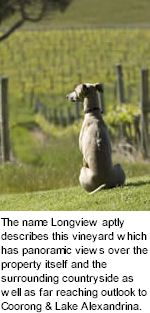
Longview is recognised as one of the Adelaide Hills’ leading vineyards
Longview Vineyard is just south of the historic township of Macclesfield in the Adelaide Hills, about 40 minutes south-east of the city of Adelaide. Since its early days as one of the area's largest dairy farms, Longview has now been meticulously restored and developed into one of South Australia's premium wine tourism destinations. The name Longview aptly describes this vineyard which has panoramic views over the property itself and the surrounding countryside as well as far reaching outlook to the Coorong and Lake Alexandrina.
|
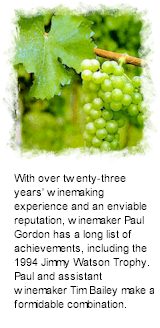
|
Leconfield was established in 1974 by noted Oenologist, Sydney Hamilton
At the fine age of seventy six, after a winemaking career spanning nearly 60 years with the family company in Adelaide, Sydney still yearned to make a classic Australian Cabernet Sauvignon and set himself the task of finding the right district in which to establish his own vineyard and winery. Showing great foresight, Sydney selected Coonawarra as the area with the potential to fulfil his ambitious dream. Thus Leconfield was born, named after an English ancestor, Lord Leconfield.
|
|
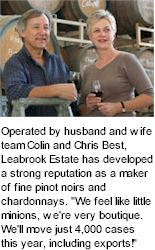
Leabrook Estate is a family-owned boutique winery located in the cool climate Adelaide Hills at Lobethal in South Australia
Leabrook Estate specialises in high quality Pinot Noir and Chardonnay and produces wines from a range of other cool climate varieties including Sauvignon Blanc, Cabernet Sauvignon, Cabernet Franc and Merlot. The story of Leabrook Estate started in 1978 around bottles of Burgundian wines at dinner parties. The wines had great character and delicacy. This was the beginning of Leabrook estate founder Colin Best's love affair with Burgundy and things Burgundian. These wines had an extra dimension of elegance and intensity.
|
|
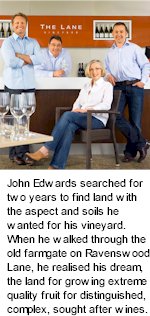
On a grey morning in July 1941, Reginald William Germein and John Crighton Edwards joined the Royal Australian Airforce. They went to war to protect their beloved country and give their children the opportunity to live, work, play and fulfil their dreams
If old buildings could talk, the hay shed at Lane Vineyard would tell quite a story. It began its days long ago in quiet solitude, the only visitors were a handful of cows and the occasional farmer with his dog. John Edwards searched for two years to find land with the aspect and soils he wanted for his vineyard. When he walked through the old farmgate on Ravenswood Lane, he realised his dream, the land for growing extreme quality fruit for distinguished, complex, sought after wines. In 1993, Edwards established new vines around the hay shed on Ravenswood Lane. From the very first wines produced under the Ravenswood Lane label in 1996, John’s belief in the terroir was rewarded with exceptional wines.
|
|
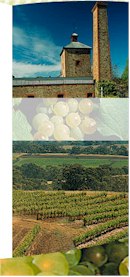
Knappstein is one of the most recognisable and popular Clare Valley wineries
Knappstein are a small producer of premium quality wines, who manage their own vineyards. Redeveloped around the historic Enterprise Brewery building at the heart of Clare township, and deeply connected to the community and cultural life of Clare. The Knappstein name has been involved in the wine business in Clare since 1895. The winery was originally founded by Tim Knappstein as Enterprise Wines, a name utilised for the premium Cabernet Sauvignon vineyard and thus honouring the Knappstein heritage as early winemakers connected with Clare for well over 100 years.
|

|
Kingston Estate Wines has grown rapidly since Sarantos and Constantina Moularadellis first developed their 40 acre vineyard in 1979 in South Australia's Riverland wine region. Today, Kingston is the 10th largest wine producer in Australia and remains one
Their son, managing director and chief winemaker, Bill Moularadellis, joined the family business in 1985 as a young Oenology graduate from Roseworthy College with a vision to produce premium wines from the Riverland. His first crush in 1986 produced 60 tonnes (principally reds) and in that year the first commercial vintage of 4,500 cases of wine was produced.
|

|
Kellermeister is a small family owned winery situated on the Barossa Valley Highway at Lyndoch, established in 1979 by Ralph and Val Jones
Ralph was National Marketing manager at Orlando wines for fifteen years prior to founding his own estate. Kellermeister have been handcrafting wines at their boutique winery for a long time now. It all began in the late 1970s as Ralph and Val Jones sat with gum boots on, ankle deep in water, labouring tirelessly into the night together. Over many cold winter’s nights, in a small tin shed perched above the valley floor, they laboured - kept warm only by the glow of the love they shared and the fire that was their dream for Kellermeister. Their aim was to produce wines of unique character - wines true to the German traditions of the Barossa Valley which was so richly influenced by the Silesian settlements of the 1840s. And so it was, through much love, sacrifice and hard work that Ralph and Val Jones brought their dream to life.
|
|
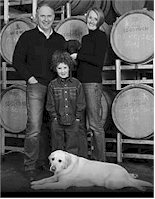
Established by Helen and Kevin O'Brien in 1997, Kangarilla Road Vineyard and Winery is based in McLaren Vale South Australia
McLaren Vale is less than an hours drive from the city of Adelaide. The region is defined by some lovely beaches on the western boundary and by low lying hills to the east. McLaren Vale is the best region in Australia to achieve the wine styles that Kangarilla Road does well. The long, dry growing season can often become indian summers, translating into Shiraz, Cabernet Sauvignon and Chardonnay fruit of aromas and flavours and balanced nicely in the reds with soft approachable tannins. In addition, the Kangarilla Road winemaking team are playing around with some new varieties to the district, namely Zinfandel and Viognier and we are very excited about the quality of these wines to date.
|
|
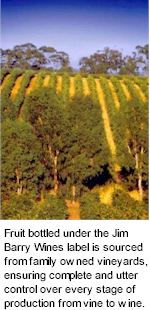
The Jim Barry vineyards were established in the cool uplands of the North Mount Lofty ranges in 1959
In his 57 years of winemaking, the late Jim Barry saw many changes. Jim Barry graduated from Roseworthy Agricultural College in 1947 and was offered a position at the Clarevale Cooperative, becoming the first qualified winemaker to work in the Clare Valley. In 1959 Jim and his wife Nancy purchased their first property on the northern outskirts of Clare and in 1964 purchased 70 acres of land from Duncan McRae Wood, part of which now forms the famous Armagh vineyard. With a growing family to look after, Jim took on the challenge of establishing his own winery and cellar door, with the first home-made wines being produced in 1974. "When I first came to the Clare Valley, grapes were delivered by horse and cart. Today our business is international but one thing won't change, at the end of the day, the wines are what matters!"
|
|
The original Jamiesons Run was a remote outback sheep station owned by the Jamiesons Brothers in the mid 1800's
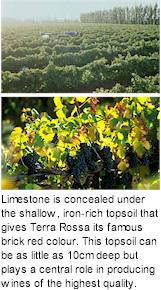
Jamiesons Run, based in the heart of the famous Coonawarra region was named as a tribute to it's pioneering past. Two men separated by time and distance laid the foundations for Jamiesons Run's creation. The first was Alfred Deakin, Australia's second prime minister with the assistance of Canadian irrigation experts William and George Chaffey and the second was John Riddoch.
|
|
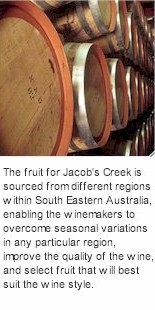
The history of Jacob's Creek begins with the earliest settlement of South Australia
Colonel William Light, who surveyed the city of Adelaide in 1836, made his way northeast to the Barossa Valley, which he named after an English victory in the south of Spain during the recent Napoleonic Wars. Later, when William Jacob surveyed the Barossa in 1839, he and his brother John took up land in the Hundred of Moorooroo; a word derived from the aboriginal meeting of two waters The two waters involved were the North Para River and a creek, which fed into it. The creek was later named Jacob’s Creek after William Jacob. Today, the Jacob brothers small cottages still stand, overlooking Jacob's Creek.
|
|
|
Howard Vineyard are all about the realization of elegant, cool climate wines, grown to a landscape of rolling vines set amongst towering gum trees on the Adelaide Hills
In 1890, Amos William Howard discovered subterranean clover thriving naturally in a picturesque valley in the Adelaide Hills. Howard Vineyard’s stone barn Cellar Door and premium red vineyard are located in Nairne, on the site of this original farm. Subterranean clover continues to grow at this site, restoring nitrogen and ensuring the health and quality of the soil in this spectacular vineyard. Thirty kilometres away, the high altitude (470m), cool climate white vineyard at Schoenthal (“Beautiful Valley” in German) is one of Adelaide Hill’s finest sites for growing fresh, crisp sparkling and white wines. These two unique vineyard sites grow exceptional white and red grapes without compromise, Howard Vineyard's Picnic, Clover and Amos wines are renowned for their delicate notes and distinctive fruit purity.
|
|
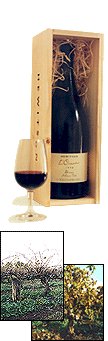
Dean Hewitson is driven by passion. His creation of individual, exquisite wines from the ancient vineyards of South Australia is for your indulgence
Dean Hewitson captures the essence of history and the magic in old vines and bottles it. His passion for wine is undeniable and his desire to share this passion is even greater. This led him to a life in which he creates wine purely for the enjoyment of others. Rather than purchasing vineyards, Hewitson made the savvy business decision to create long term associations with a network of established growers, allowing him to seek out the varietals he desired.
|
|
Henschke is one of the longest established family names in the Barossa
Johann Christian Henschke purchased land for a farm at Keyneton in 1861, after fleeing religious persecution in Silesia. He planted a small vineyard and an orchard, and after initially making wine for family consumption produced his first commercial vintage in 1868, believed to be principally riesling and shiraz. Each subsequent generation built upon the reputation for quality, but it was fourth-generation Cyril Alfred Henschke who in 1958 created the wine that has most captured the red wine world's imagination - Hill of Grace.
|
|
|
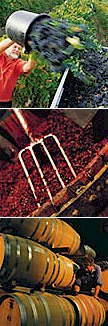
Heirloom Vineyards were conceived in vintage 2000, when a young winemaking student caught the eye of a silly old wine judge
A love story ensued inspired by two vows, to preserve the best of tradition, the old world of wine and unique old vineyards, to champion the best clones of each variety planted in the most appropriate sites, embracing the principals of organic and biodynamic farming. Seven long vintages of trial and error passed before Heirloom Vineyards could make a wine that was fine enough to pass on to future generations. That is this wine.
|
|
Thomas Hardy left Devon in 1850 at the age of 20 and migrated to the new colony of South Australia
He established a winery on the banks of Adelaide's River Torrens in 1853. His Bankside winery was the start of an outstanding family wine business that grew to become one of the world's great wine companies. Thomas Hardy was a self-made man, a pioneer of immense character. With a mixture of energy, determination, shrewd judgment, innovation and a touch of daring, he pursued the highest standards in winemaking. At Bankside, and later at his McLaren Vale property Tintara, he focused on quality and craftsmanship. Tintara was to become the centre of Hardy's enterprise and by the late 1800s was one of the best-equipped and managed wineries in Australia. This success was substantially due to Hardy's initiatives in planting higher quality, lower yielding varieties rather than the coarser, heavier-yielding types more common at the time. His willingness to experiment with and to use novel equipment, much of which he designed and built himself, also contributed to this success.
|
|
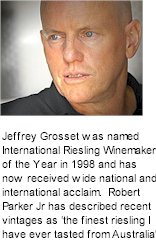
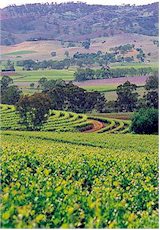
Grosset Wines is an independently owned winery set in the Clare Valley producing just six highly regarded premium wines each vintage
Established in 1981 by Jeffrey Grosset in the historic township of Auburn in the southern tip of the Clare Valley 100 kilometres north of Adelaide, the winery is stylish but functional and reflects the attention to detail that extends to the Grosset estate-owned Clare Valley vineyards and to the winemaking.
|
|
Established in 1988, Grant Burge Wines has grown to become one of the top 10 privately owned wine companies in Australia.
The company has a strong commitment to its loyal Australian consumers and also energetically pursues overseas markets in the United Kingdom, Europe, Canada, the United States and Asia. Grant Burge is a fifth generation winemaker absolutely committed to the Barossa Valley. He strongly believes that fine wines are born in the vineyard and that vineyards are the cradle of wine quality.
|
|
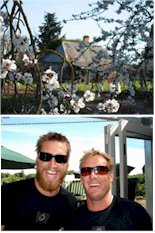
Gibson's BarossaVale Wines is a small family owned winery nestled at the northern end of the Barossa Valley in South Australia
A specialist producer of limited quantities of premium table wines, it is fast garnering a reputation as a reliable producer of richly flavoured and complex wine. Owned by Rob Gibson and wife Anne, the tiny operation produces a mere 4000 cases of wine. Fruit is sourced from predominantly estate grown fruit with a small amount coming from contracted grower fruit for added diversity come blending time.
|
|
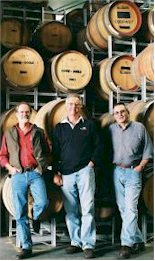
A bottle of good wine can help solve many problems, such were the thoughts of Norm Doole and Drew Dowie as they watched the sun rise after enduring a cold, all-night session harvesting some of their fruit from the difficult 1995 vintage
Seeing their grapes being trucked away to other wineries and frustrated at not being in control of their fruit from that point, the two opened a bottle of red wine over breakfast and decided then to form a partnership, the purpose of which was to take charge of all aspects of growing grapes, making, bottling and selling their own wine.
|
|
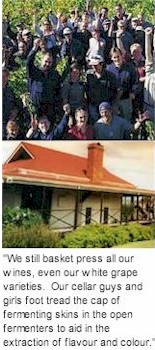
The heart of McLaren Vale, past and present, d’Arenberg is one of the most significant wineries in Australia
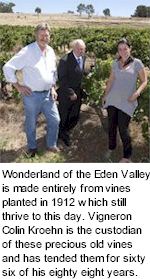
In 1912 Joseph Osborn, a teetotaller and director of Thomas Hardy and Sons, purchased the well established Milton Vineyards of 25 hectares in the hills just north of the townships of Gloucester and Bellevue, now known as McLaren Vale. Joseph’s son Francis Ernest (‘Frank’) Osborn left medical school, choosing to forsake the scalpel for pruning shears. He soon increased the size of the vineyard to 78 hectares. Fruit was sold to local wineries until the construction of his own cellars was completed in 1928. Dry red table and fortified wines were produced in ever increasing quantities to supply the expanding markets of Europe.
|
|
Dandelion Vineyards really do wish you were here
Their vineyards are family, their wines are children. Serious stuff, certainly. Proper fun, absolutely. The lifelong search to appreciate and understand the essence of wine, its terroir, leads to a vinous treasure hunt, following the Dandelion's wishing clock if you will, that always inspires. Dandelion Vineyards are proven plantings that have stood the test of time.
|

|
Brian Croser, chief winemaker of Petaluma has been closely involved in the administration and evolution of the modern Australian wine industry.
Established by Brian Croser in 1976, Petaluma is one of Australia's most prominent wine companies. Brian was the head winemaker for Thomas Hardy & Sons before establishing the Riverina College of Advanced Education course of Wine Science and Viticulture in 1976. While at the Riverina College he worked as a consultant to leading wineries and also established the Petaluma wine business in 1976.
|
|
|
Cleanskin
|
|
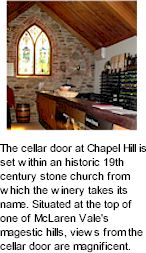
Chapel Hill takes its name from the historic ironstone church built at the property in 1865
Chapel Hill Winery is entirely in the Hills Face Zone. In 1990 environmental consultants were briefed to advise regarding development in this sensitive rural preserve. The estate obtained planning approval from the Minister for Environment and Planning in 1991, and built the winery in 1993. Chapel Hill is the embodiment of the wine and food experience delivered using the best of environmental practices by people who are passionate about their product and the McLaren Vale winegrowing region.
|
|
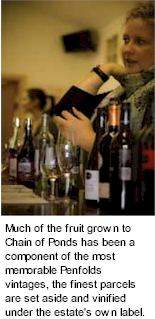
The Chain of Ponds winery was established in 1985 on the outskirts of Gumeracha, approximately 4km from the original township
The Chain of Ponds initially described a creek which ran all the way from beyond Kersbrook to its confluence with the River Torrens near Prairie in the Adelaide Hills, South Australia. The area was dotted at regular intervals with small ponds, having no visible connection above the ground but never drying up even in the driest, hottest summers. Much of the chain of water holes known as the Chain of Ponds vanished under the waters of the Millbrook Reservoir in 1918. While vineyards have been part of the makeup of the area since colonisation, the Chain of Ponds Winery was the first major planting of any note in the northern area of the Adelaide Hills region.
|
|
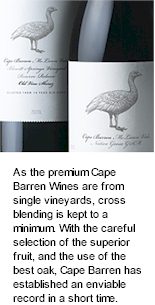
Cape Barren Wines create generous and profound wines, sourced from some of South Australia's finest vineyard sites
Located in the renowned McLaren Vale region of South Australia, the Cape Barren vineyards benefit from the unique maritime climate of long warm summers cooled by afternoon ocean breezes, ideal conditions for grapes destined for full-bodied red wines. Starting from humble beginnings with the first vintage in 1999, Cape Barren Wines is the result of a 35 year friendship between Peter Matthews, who has 30 years experience in executive Sales and General Management, and Brian Ledgard, a third generation grape grower, and their lifelong interest in vineyards and wine. Their ambition was and is, to produce full bodied wine of uncompromised quality and excellence.
|
|
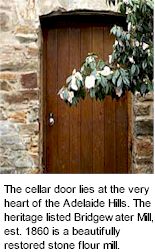
The unique combination of the Adelaide Hills chilly climate, diverse soils and natural elevation all play a major part in making the Bridgewater Mill wines so special
Made by the Petaluma winemaking team, Bridgewater Mill is focussed on producing cool climate Adelaide Hills wines. When coupled with the winemaker's integrity and focus on preserving the cool, crisp fruit from vineyard to bottle, what ends up on your table is a sophisticated yet simple wine designed to enjoy and to share. The perfect accompaniment to any meal, whether you're fine dining or lunching with friends.
|
|
The Laira Vineyard was established in 1893 on the Coonawarra’s famous terra rossa heartland
Brands Laira is today widely regarded as one of the region’s best plantings of Shiraz. With Shiraz being the only wine grape planted in Coonawarra from 1900 to 1950, the variety has played an important role in establishing Coonawarra’s international reputation as Australia’s pre-eminent red wine region.
|

|
Bondar are a little winery headquarted at the iconic Rayner Vineyard, on the corner of Chalk Hill Road and Twentyeight Road in McLaren Vale
Bondar wines began its life in 2012, after a small group of family and friends hand picked a couple of tonnes of Shiraz grapes for their first ever wine. It was a beautiful, calm, warm summer's evening, and when the sun went down the McLaren Vale sky lit up with one of the most spectacularly beautiful sunsets they had ever seen. Bondar's Violet Hour Shiraz was born out of the inspiration from this magical moment. They have since won multiple trophies at the McLaren Vale Wine Shows and have been named one of the Top 50 Young Guns of Wine.
|
|
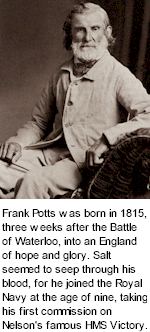
Bleasdale is Australia's second oldest, still functioning family owned winery. Bleasdale's wines are the stuff of legend and receive accolades around the world every year
Established in 1850 by English migrant Frank Potts, the Bleasdale vineyards are situated on the fertile flood plains of the Bremer River which run parallel to Langhorne Creek. The area is a low rainfall, cool climate region which produces outstanding wines year after year. Ironically, it was Frank Potts abilities as a sailor that led him to Langhorne Creek to live the life of a landlubber. He saw the potential of the region when he explored it in the 1850s, convinced that the stands of tall red gums promised fertile soils and reliable water. Being a nautical man, it's not surprising that Frank Potts chose to plant a vineyard in a place that for a week or two occasionally becomes an inland sea. He planted his first vines in 1858 selling wine to Thomas Hardy, before expanding his holdings to 30 acres in the 1860s. Since Pott's founding efforts, Langhorne Creek's alluvial soils and favourably cool climate, nurtured by maritime breezes, has attracted many famous winemakers.
|
|
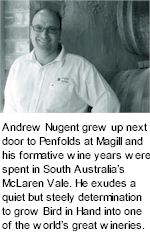
In 1997, an unassuming young viticulturalist and winemaker, Andrew Nugent, chanced his arm in the emerging wine region of the Adelaide Hills
Nugent grew up next door to Penfolds at Magill and his formative wine years were spent in South Australia's McLaren Vale. It was here that he honed his craft as a viticulturalist, vineyard manager and winemaker. In 1997, Nugent planted vineyards and an olive grove on 100 acres on Bird in Hand Road, Woodside. The road itself was named after the Bird in Hand gold mine that operated in the district in the 1850s. The Nugent family now live and work on the picturesque property, reflecting the strong sense of community in the Adelaide Hills.
|
|
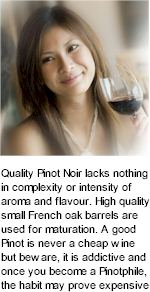
Barratt Wines, acclaimed for its award winning specialty Pinot Noir, is a family owned and operated winery in the Piccadilly Valley, the premium grape growing region of South Australia's Adelaide Hills
Lindsay Barratt was previously a physician and retired entirely from medicine in 2001 to realise his dream of handcrafting the wine from beginning to end - growing and caring for the vines (which he has done since 1990 when the Uley property was acquired) and, since 2001, taking the grapes through the process of specialised winemaking. After having achieved his Graduate Diploma in Oenology at the University of Adelaide in 2002, he has taken control of all the wine produced under the Barratt label at the Lobethal winery. Barratt sources grapes from two small vineyards, Uley and Bonython, to produce quality wines handcrafted to exacting standards. The Adelaide Hills are a challenging region in which to grow grapes and make win and Lindsay Barratt loves a challenge!
|
|
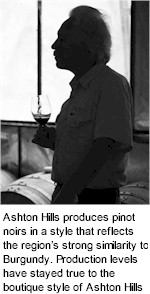
Stephen George is one of the most naturally gifted winemakers in Australia, an early pioneer of the well established viticultural precincts on Adelaide Hills
Stephen established his 3ha dry grown Ashton Hills Vineyard in the Piccadilly Valley in the early 1980s and began producing its first wines in 1987. The style reflects the region’s strong similarity to Burgundy and production levels have stayed true to the boutique nature of the winery’s beginnings. The Ashton Hills Vineyard provides the fruit for the majority of Ashton Hills wines including single vineyard wines in the Reserve Pinot Noir, Estate Pinot Noir and Riesling. As custodian of the vineyard for over 30 years, Stephen has harnessed the three key climate variables (humidity, temperature and rainfall) he believes are critical to the Ashton Hills site and developed a reputation for producing some of the finest wines from the Adelaide Hills.
|
|
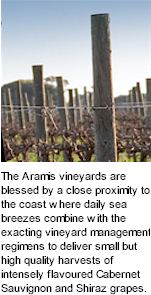
Aramis Vineyards, completely McLaren Vale, family owned, estate vinified and estate grown
Aramis hve been awarded a staggering amount of awards and accolades at Australian and international wine shows in recent years. The vineyards are planted on their own rootstock to some of the world’s oldest mineral rich soils and in the most temperate of Mediterranean climates. The vines consistently produces excellent fruit quality from low yielding vines. Only the best parcels of fruit are carefully selected from the vineyard and bottled under the Aramis label. Great attention to detail with the integration of fruit flavours and fine oak barrels helps produce classic handcrafted styles of wine. Aramis have pursued their passion to produce rich and intensely flavoured wines. There are 64 acres planted, the majority of which is dedicated to Shiraz and Cabernet Sauvignon. Knowledge of the vineyard is paramount, with meticulous management and tireless commitment to achieve fruit of the highest standard.
|
|
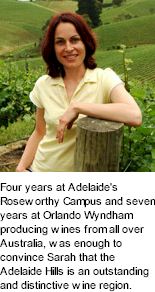
Winemaker Sarah Fletcher, had a very clear vision for Alta from day one
Sarah wanted to showcase South Australia's Adelaide Hills as an outstanding cool climate wine region, selecting specific varieties and handpicking quality fruit. This has allowed her to create fresh, varietal wine styles with depth and obvious regional character. "My aim is to produce wines from varieties that thrive in the cool climate of the Adelaide Hills, each showing strong varietal character and distinctive regional expression."
|
|