|
|
CoonawarraSouth Australia

|
Zilzie
|
|
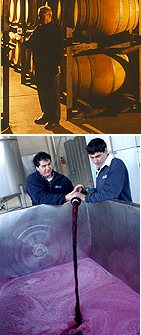
Grape growing and winemaking has been a large part of the Zema Family history and heritage dating back to the 1800s
Matteo Zema opened the first wine bar/tavern in Armo, Reggio Calabria in 1835, much to the angst of the local authorities at the time. Although the tavern no longer exists, it was this legacy and a passion for wine that has been passed down from generation to generation. After migrating to Australia, Nicola Zema started working for Wynns in 1953, hand pruning, picking and planting, a job that continued through until his retirement in 1975.
|

|
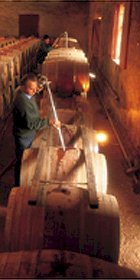
Yalumba, Australia's oldest family owned and operated winery, has a wealth of history and tradition
Yalumba was founded in 1849 by Samuel Smith, British migrant and English brewer, who had brought his family to Angaston seeking a new life. After purchasing a 30-acre parcel of land just beyond the southern-eastern boundary of Angaston, Smith and his son began planting the first vines by moonlight. Samuel named his patch Yalumba, aboriginal for 'all the land around'.
|
|
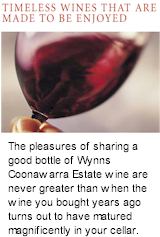
Nestled in the heart of Coonawarra is the famous three-gabled Wynns Coonawarra Estate winery 400km south east of Adelaide South Australia
The oldest operating winery in the region, today visitors are invited to enjoy a tasting of current and back vintage wines in a world-class tasting facility. Time spent at Wynns Coonawarra Estate leaves visitors with a powerful and lasting impression of Coonawarra.
|
|
The Wolf Blass winery is located at the epicentre of the Australian wine industry, the Barossa Valley and has produced some of Australia's finest wines since 1966
Wolf Blass Wines International was born in 1973 when Wolf started his own business, purchasing a 2.5 acre land holding with an old army shed outside Nuriootpa, at the northern end of the Barossa Valley. John Glaetzer joined the company and from 1974-1976 Wolf Blass Wines won three consecutive Jimmy Watson Trophies, the Black Label generated substantial publicity and hype. From this time onwards growth was impressive with Wolf Blass Yellow Label and Riesling becoming Australia's top selling red and white wine.
|
|
|
Whodunnit
|
|
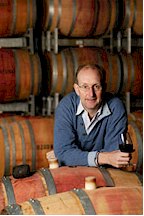
Situated at the very heart of South Australia’s beautiful Clare Valley, Taylors has become one of Australia’s best loved and most trusted wineries
The tale of Taylors winemaking goes back a few years – three generations in fact, and all began with Bill Taylor Senior, and his love of a certain Bordeaux wine. Originally wine merchants in Sydney, a passion for wine was all part of being a Taylor, and in particular, for the famous French Clarets such as Chateau Mouton Rothschild in Bordeaux’s Medoc region. It was this long held fascination for these wines which inspired the family’s foray into winemaking, and provides the inspiration and winemaking philosophy behind all Taylors winemaking today – to produce premium wines of exceptional and comparable quality in Australia.
|
|
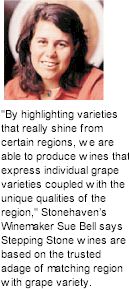
Stonehaven opened in March 1998, and is located just 6km south of Padthaway, the gateway to South Australia's Limestone Coast
Stonehaven takes its name from one of its vineyards which originally formed part of the pioneering Hynam Station established by one of the region's first settlers Adam Smith in 1846. Stonehaven features the latest winemaking technology that provides the winemaker with unprecedented control over the winemaking process, allowing them to maximise the special characters of every batch of premium fruit that comes into the winery.
|
|
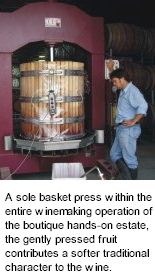
St Marys is a boutique, family owned, premium red wine producer, sited on some of the Coonawarra's most unique mix of soils.
St Mary's winery is situated on a strip of "terra rossa" soil 15 kilometres west of the township of Penola in the southeast end of South Australia. In 1909 the first members of the Mulligan family arrived in the Penola district. The property that St Marys Wines now stands upon was purchased in 1937. This property is 15km west of the town of Penola. Its primary use was for sheep and cattle grazing.
|
|
St Hugo honours the visionary leader; Hugo Gramp, who successfully built Gramp & Sons winery into an industry pillar inspiring progress across future generations of the Gramp family
A true visionary and a man of great intellect, Hugo Gramp was a linguist, businessman and expert winemaker who felt a great sense of connection with Australian terroir, which he proved to the world, could create internationally acclaimed, award winning fine wines. The modern iteration of St Hugo was launched with the 1980 vintage to honour Hugo Gramp, the grandson of Johann Gramp who planted his first vines in the Barossa Valley in 1847. Hugo Gramp succeeded his father at the head of the Gramp & Sons family business, at the age of 25. Hugo's leadership and passion for wine set the company on a path of extraordinary growth.
|
|
The Rymill winery, steeped in history, is situated within The Riddoch Run Vineyards at the northern end of the famous Terra Rossa strip
Coonawarra patriarch John Riddoch struck gold at the Ovens Valley goldfields in 1852, before establishing himself as a wholesale wine and general merchant in Geelong. He eventually settled near Penola, at shearing time in 1861. The Riddoch Run eventually expanded to 50,000ha, carrying 110,000 sheep and 3,000 cattle, and extended from Comaum in the north to Mt Gambier Airport in the south. During his subsequent four decades of community service Riddoch was Chairman of the Penola District Council for 25 years, and also the local Member of Parliament from 1865 to 1873, obtaining roads and education for the region. The Riddoch Highway and Mt Gambier's Riddoch Art Gallery currently commemorate his name.
|
|
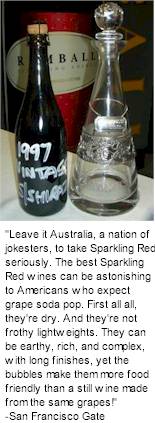
Peter Rumball is an Australian specialist Méthode Champenoise Sparkling Winemaker who led the 1980's renaissance of sparkling red wines
His style has made him famous in Australia. Peter Rumball loves this style so much, Sparkling Red wine is now the majority of sparkling wine that he produces. The wine is heavy in varietal character. Shiraz and Merlot are used. Big, full basewines are made from these grapes, they have great depth of colour and fruit character, exclusive of high alcohol.
|
|
|
Right at the heart of Coonawarra are the Rouge Homme Vineyards, established in 1908 when the Redman family purchased part of John Riddoch's Penola Fruit Colony
For half a century, the Rouge Homme winemakers supplied wine to other companies and merchants. With the inaugural release of the 1954 Cabernet Sauvignon, Rouge Homme as a winery itself began to attract some of the fame. Rouge Homme, French for Red Man, signified the similarity of the wines to the red wines of Bordeaux. The Rouge Homme Richardson's label was introduced with the 1992 vintage and named in honour of Henry Richardson. In 1892 Henry Richardson, one of the earliest Coonawarra pioneers, purchased land from the region's founder John Riddoch, and established a vineyard winery on the property.
|
|
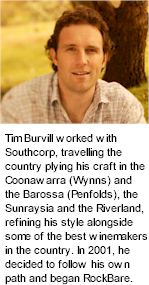
RockBare was born out of Tim Burvill's desire to create his own wine from fruit grown to Australia's best viticultural regions
Growing up in Western Australia, Tim's interest in wine was sparked at a young age by frequent summer holidays to the Margaret River region. He fell in love with the world of wine, his passion eventually saw him move to South Australia, where he completed an honours degree at Adelaide University's Roseworthy Campus. His first job was with Southcorp, which as Tim puts it "was the best start to a winemaking career that anyone could ask for." For the next 5 years Tim worked with Southcorp, travelling the country plying his craft in the Coonawarra (Wynns) and the Barossa Valley (Penfolds), the Sunraysia and the Riverland, refining his style alongside some of the best winemakers in the country. A rapid rise through the ranks soon saw him vested with the responsibility at the age of 25, of making Southcorp's ultra-premium white wines, including Penfolds Yattarna. In 2001, Tim decided to follow his own path and began RockBare, focusing on Chardonnay and Shiraz from South Australia's McLaren Vale.
|
|
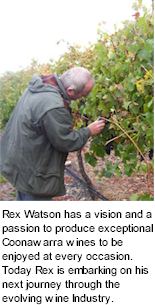
Rex Watson commenced business in the Australian Wine Industry in 1991 and began growing wine grapes in Coonawarra in 1997
In 1999 he commenced the planting of the most significant modern vineyard development in Coonawarra. In less than 5 years this was built into a venture that owns controls and manages almost 1,000 acres over three vineyards, all close to the historic township of Coonawarra and well within the geographically defined Coonawarra region. Currently Rex is the largest independent grape grower in the world-famous Coonawarra region. At full capacity the vineyards have the potential to produce up to 400,000 cases of premium Coonawarra wine from their own fruit. This presents the opportunity to consistently produce high volume, high quality premium wines year after year.
|
|
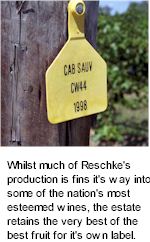
The Reschke history and its close relationship with Coonawarra began over a century ago with the establishment of a farming and grazing enterprise
It is cattle grazing heritage that is reflected in the Reschke logo of the bull. Four generations later in 1989 Burke Reschke embarked on a development of estate vineyards in what is still primarily a cattle property. The demand for the Reschke wine grapes throughout the nineties saw the fruit being used for some of Australia's Icon wines. In 1998 a selection of the most outstanding Cabernet Sauvignon parcels was released under the first Reschke label Empyrean.
|
|
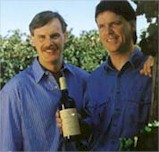
Since the first Coonawarra vine gnarled its way heavenward, the Redman name has been synonymous with the region
The Redman family, Redman winery, red soil and red wine are the four R's that comprise the Redman coat of arms. All interdependant upon each other, they work in harmony to produce the famous wines of Coonawarra. The association began in 1901 when Bill Redman, at the tender age of fourteen arrived in South Australia's South East to work in the vineyards. He quickly formed an affiliation with the area and six years later encouraged the rest of his family to join him.
|
|
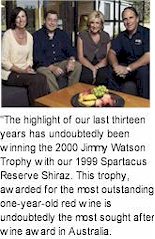
Centrally located in Australia's world class Coonawarra winegrowing district, Punters Corner is a boutique estate, and proudly, home to the 2000 Jimmy Watson Memorial Trophy
Coonawarra, the aboriginal word for wild honeysuckle, is the name all associate with Australia's premier table-wine district, the dry red wines are amongst the best in the world. The Coonawarra viticultural area is based on the small area of terra rosa soil stretching north from Penola for fifteen kilometres and restricted to only two to three kilometres in width. Early assessments of Coonawarra area recognised the suitability of the natural elements of the district for vine growing.
|
|
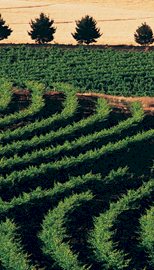
Established by Brian Croser in 1976, Petaluma is one of Australia's most prominent wine companies.
The pre-eminent quality of Petaluma's wines is based on distinguished vineyard sites for each of the chosen varieties, in four important South Australian wine regions - Piccadilly Valley in the Adelaide Hills, for Pinot Noir and Chardonnay - Mount Barker in the Adelaide Hills, for the Rhone varieties Viognier and Shiraz - Clare Valley, for Riesling and - Coonawarra, for Cabernet Sauvignon and Merlot
|
|
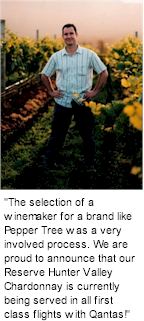
Although Pepper Tree winery is sited in the Hunter Valley and founded as a Hunter Valley winery, the winemakers believe that grapes grown in other regions exhibited characters that should be explored
Over the years Pepper Tree have acquired vineyards in the Orange, Wrattonbully and Coonawarra growing areas to enable the winemaker production of varietal wines that either did not grow as well in the Hunter Valley, or are different expressions of a particular varietal that are of interest to connoisseurs of fine wines. The character and complexity reflected in the Appellation wines are an expression of diverse vineyard resources. A second is the balance and elegance in the Multi-Regional range of varietals. These are blends of a varietal wine made from grapes grown at two or more of vineyards that vary from year to year. All Pepper Tree wines are produced, aged and bottled at the winery.
|
|
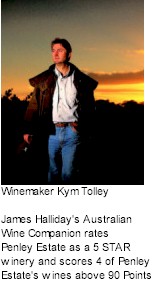
Penley Estate is a medium sized winery and vineyard located in the Coonawarra, and is the chosen home of winemaker Kym Tolley
The mission of Penley Estate and Kym Tolley is to produce a selection of wines with an emphasis on quality of product as well as the skill, enthusiasm and artistry of the team of people involved in the wine making process. Kym has always had wine in his blood, he is a direct descendant of two of Australia's most famous winemaking families, the Penfolds and the Tolleys.
|
|
Penfolds was founded by a young English doctor who migrated to one of his country's most distant colonies a century and a half ago
Dr Christopher Rawson Penfold was born in 1811, the youngest of 11 children. He studied medicine at St Bartholomew's Hospital, London, graduating in 1838. Like many doctors before and since, Dr Penfold had a firm belief in the medicinal value of wine. Before he left Britain he had obtained vine cuttings from the south of France and these were planted around the site of the modest stone cottage he built with his wife, Mary, at Magill on the outskirts of Adelaide in 1845. The couple called this house The Grange, after Mary's home in England.
|
|
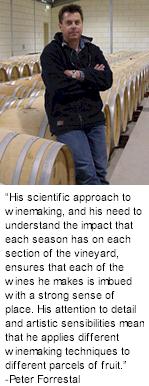
Parker Coonawarra Estate wines have achieved an unmatched reputation both within Australia and in all countries where fine wines are revered for integrity and consistently superb quality
Parker Coonawarra Estate is situated in Coonawarra, at the centre of South Australia's Limestone Coast Wine Region. It is approximately 3 1/2 hours south of Adelaide, the capital of South Australia, and about 4 hours west of Melbourne, the capital of Victoria. Only a short drive from Coonawarra to the east is the beautiful Grampians Region, and the stunning Great Ocean Road to the south east.
|
|
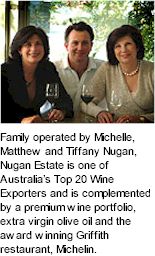
Nugan Estate is a story of inspiration about a premium producer of estate grown wine based in Griffith New South Wales
The Nugan Group was founded in 1940 when a young Alfredo Nugan emigrated from Spain with his family to start a small fruit and vegetable packing operation in Griffith, New South Wales. Nugan's daughter in-law Michelle became responsible for the Group’s renaissance into one of Australia’s most successful agricultural enterprises. Looking beyond Australia’s shores, Nugan became the largest exporter of niche juice products to Asia in the Southern Hemisphere with production in excess of 70,000 tonne per annum.
|
|
And, yes.. Ben does have a vineyard
Located at Kangarilla on the edge of the McLaren Vale designated region, Piebald Gully is a recently planted patch producing fine grade Shiraz, Viognier and Petit Verdot from low yielding hand tended vines. Besides 22 vintages in Australia, Ben has presided over a further eight overseas. Experience has been gained in the Napa Valley, Bordeaux, Greece, Italy and the South of France which gives Ben a broad appreciation of wine styles and winemaking practices. A graduate of Roseworthy (in 1985), Ben has made a major contribution to regional wine industry activities having served 10 years as a board member of McLaren Vale Winemakers Inc. Three of those years saw Ben in the role of Chairman. He also chaired the McLaren Vale Wine Show over a 5-year period. Wines made by Ben have achieved considerable Wine Show Awards success including winning the first two Great Australian Shiraz Challenges. More than 20 trophies have been won and in 1993, Wirra Wirra 1991 Angelus was declared the winner of the Sydney International Top 100 wine awards.
|
|
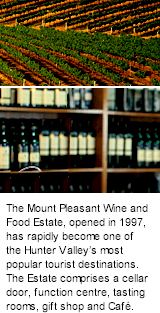
McWilliam’s Mount Pleasant Estate nestled in the slopes of the Brokenback Range in the Hunter Valley was established in 1921 by legendary winemaker, Maurice O’Shea
The Griffith-based McWilliam family, already a famous Australian wine company, purchased a half share of the Estate and encouraged O’Shea to continue with his winemaking style and creations. McWilliam’s acquired the remaining share in 1941. It was with the McWilliam family’s financial backing O’Shea selected and purchased the Lovedale and Rosehill properties and planted them in 1946. O’Shea’s groundbreaking work has been kept alive by revered winemakers Brian Walsh and Phil Ryan. The fact that there have been just three Chief Winemakers at Mount Pleasant since 1921 has ensured consistency of wine style and quality.
|
|
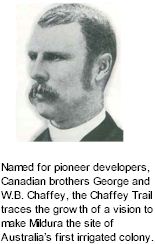
Mildara Wines was at the vanguard of the rediscovery of the Coonawarra region
William Benjamin Chaffey (born in 1856 in Brockville, Ontario) was a Canadian engineer who with his brother George, developed the California cities of Etiwanda, Ontario, and Upland, as well as Mildura in Victoria. He established irrigation companies in both Mildura and in Renmark, where he is still held in veneration. His company, Chaffey Brothers Ltd, went into liquidation in 1894. He remained in Mildura, becoming mayor in 1920, establishing an orchard, and the Mildura (later Mildara) Winery Pty Ltd.
|
|
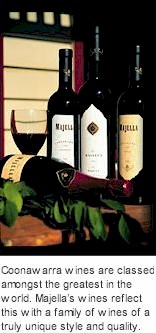
The Lynn family have been residents of the Penola - Coonawarra district for over four generations, starting out as Store-Keepers and then graduating into grazing
The property on which Majella now stands was originally owned by Frank Lynn, and bought by his nephew, George, in 1960. George and Pat Lynn kept Merinos for wool production on their farm about ten miles away, and had always wanted some good Coonawarra country for their up-and-coming prime lamb enterprise. Viticulture, however, was not on their agenda until 1968.
|
|
Lindemans promise more than the partnering of quality grapes and craftsmanship. Every wine contains the spirit and passion of founder Dr Henry J Lindeman
A graduate of London’s famous St. Bartholomew’s Hospital, Henry Lindeman discovered winemaking while travelling through Europe in the late 1830s. Fascinated by wine’s medicinal benefits, he devoted much of his time to learning the skilful craft. In 1840, he returned to England to marry Eliza Bramhall and within weeks, the couple embarked on a four-month voyage to start a new life in the Australian colonies.
|
|
Leconfield was established in 1974 by noted Oenologist, Sydney Hamilton
At the fine age of seventy six, after a winemaking career spanning nearly 60 years with the family company in Adelaide, Sydney still yearned to make a classic Australian Cabernet Sauvignon and set himself the task of finding the right district in which to establish his own vineyard and winery. Showing great foresight, Sydney selected Coonawarra as the area with the potential to fulfil his ambitious dream. Thus Leconfield was born, named after an English ancestor, Lord Leconfield.
|

|
Kingston Estate Wines has grown rapidly since Sarantos and Constantina Moularadellis first developed their 40 acre vineyard in 1979 in South Australia's Riverland wine region. Today, Kingston is the 10th largest wine producer in Australia and remains one
Their son, managing director and chief winemaker, Bill Moularadellis, joined the family business in 1985 as a young Oenology graduate from Roseworthy College with a vision to produce premium wines from the Riverland. His first crush in 1986 produced 60 tonnes (principally reds) and in that year the first commercial vintage of 4,500 cases of wine was produced.
|
|
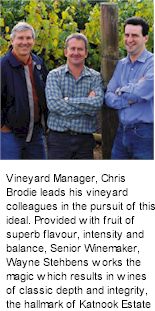
Katnook Estate is one of the most esteemed domains in Australia's premier red wine district, the Coonawarra
Its vineyards, planted in prime Terra Rossa soil, span 330 hectares in the heart of this comparatively small and remote region in the south east corner of South Australia. From here come red wines that have contributed to Coonawarra's international reputation and white wines with equally distinctive attributes.
|
|
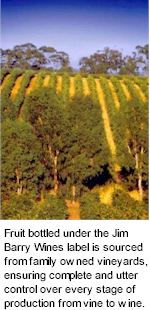
The Jim Barry vineyards were established in the cool uplands of the North Mount Lofty ranges in 1959
In his 57 years of winemaking, the late Jim Barry saw many changes. Jim Barry graduated from Roseworthy Agricultural College in 1947 and was offered a position at the Clarevale Cooperative, becoming the first qualified winemaker to work in the Clare Valley. In 1959 Jim and his wife Nancy purchased their first property on the northern outskirts of Clare and in 1964 purchased 70 acres of land from Duncan McRae Wood, part of which now forms the famous Armagh vineyard. With a growing family to look after, Jim took on the challenge of establishing his own winery and cellar door, with the first home-made wines being produced in 1974. "When I first came to the Clare Valley, grapes were delivered by horse and cart. Today our business is international but one thing won't change, at the end of the day, the wines are what matters!"
|
|
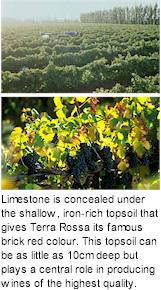
The original Jamiesons Run was a remote outback sheep station owned by the Jamiesons Brothers in the mid 1800's
Jamiesons Run, based in the heart of the famous Coonawarra region was named as a tribute to it's pioneering past. Two men separated by time and distance laid the foundations for Jamiesons Run's creation. The first was Alfred Deakin, Australia's second prime minister with the assistance of Canadian irrigation experts William and George Chaffey and the second was John Riddoch.
|
|
|
Jacaranda Ridge
|
|
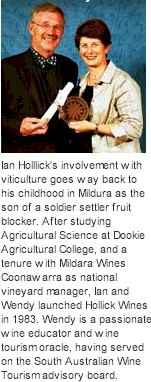
The Hollick vineyard and winery is located on the Neilson's Block, one of the original John Riddoch sites in the Coonawarra
Driven by quality and a hands-on approach, Hollick wines are made from three core vineyards. Neilson's Block, re-planted by Ian and Wendy Hollick in 1975, the nearby Wilgha vineyard, purchased in 1987 and the Red Ridge vineyard developed in 1998 at Wrattonbully, giving Hollick over 200 acres of vineyard in total. Eighty percent is planted to red varieties, including Cabernet Sauvignon, Merlot, Cabernet Franc, Shiraz, Pinot Noir, Sangiovese and Petit Verdot. The balance of the vineyards are planted to the white varieties of Chardonnay, Riesling, Sauvignon Blanc and Semillon.
|
|
|
Heirloom Vineyards were conceived in vintage 2000, when a young winemaking student caught the eye of a silly old wine judge
A love story ensued inspired by two vows, to preserve the best of tradition, the old world of wine and unique old vineyards, to champion the best clones of each variety planted in the most appropriate sites, embracing the principals of organic and biodynamic farming. Seven long vintages of trial and error passed before Heirloom Vineyards could make a wine that was fine enough to pass on to future generations. That is this wine.
|
|
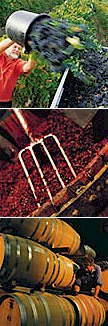
Thomas Hardy left Devon in 1850 at the age of 20 and migrated to the new colony of South Australia
He established a winery on the banks of Adelaide's River Torrens in 1853. His Bankside winery was the start of an outstanding family wine business that grew to become one of the world's great wine companies. Thomas Hardy was a self-made man, a pioneer of immense character. With a mixture of energy, determination, shrewd judgment, innovation and a touch of daring, he pursued the highest standards in winemaking. At Bankside, and later at his McLaren Vale property Tintara, he focused on quality and craftsmanship. Tintara was to become the centre of Hardy's enterprise and by the late 1800s was one of the best-equipped and managed wineries in Australia. This success was substantially due to Hardy's initiatives in planting higher quality, lower yielding varieties rather than the coarser, heavier-yielding types more common at the time. His willingness to experiment with and to use novel equipment, much of which he designed and built himself, also contributed to this success.
|
|
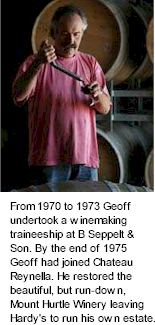
The Geoff Merrill winemaking philosophy has been and always will be, to make wine that allows regional, varietal and vintage expression, without excessive winemaker intervention
The history of the Geoff Merrill Mount Hurtle winemaking operations begins over 100 years ago when the site was built by a young Englishman, Mostyn Owen, who purchased 200 acres of prime Reynella hillside and built a winery in 1897. Set in the Hurtle Vale Ward just behind Reynella (Hurtle Vale was named after Sir James Hurtle Fisher, the first Mayor of Adelaide). Of these 200 acres, 150 were planted with vines. Mostyn Owen ran the winery and vineyards until he passed away in the mid 1940s. Mount Hurtle was innovative for its time, using the principles of gravity to feed wine throughout the cellars. Because of this the building is now state heritage listed.
|
|
|
Cleanskin
|
|
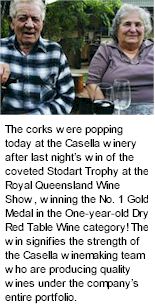
The Casella family has been making wine since 1820 in Italy, and since 1965 in Australia
Filippo and Maria Casella emigrated to Australia from Italy in the 1950s bringing with them their hopes and dreams and the know-how acquired through three generations of grape-growing and winemaking in Italy. Recognising the potential of the region, Filippo purchased a farm in the town of Yenda, New South Wales, in 1965. After selling the grapes from his farm to local wineries, he decided in 1969 that it was time for a new generation to put its winemaking skills to use, and the winery was born.
|
|
The Laira Vineyard was established in 1893 on the Coonawarra’s famous terra rossa heartland
Brands Laira is today widely regarded as one of the region’s best plantings of Shiraz. With Shiraz being the only wine grape planted in Coonawarra from 1900 to 1950, the variety has played an important role in establishing Coonawarra’s international reputation as Australia’s pre-eminent red wine region.
|
|
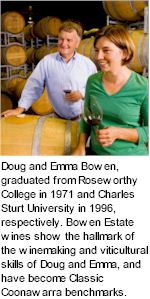
Owned and operated by the Bowen family, Bowen Estate lies towards the southern end of the famous Coonawarra wine region
Proprietor/ winemakers Doug and Emma Bowen, graduated from Roseworthy College in 1971 and Charles Sturt University in 1996, respectively. Starting with bare paddocks that had until then been part of a dairy farm, the vineyard area was originally 12 hectares. Established in 1972 on prime Terra Rossa soil, the first vintage from Bowen Estate was 1975. The Cellar Door tasting and sales facility was opened to the public in 1977. The South Block, originally a sheep farm was purchased in 1986. In 1996 a property with some established vines, was purchased directly on their northern boundary.
|
|
Balnaves are a small but very proud wine family owned wine company in the heart of the famous Coonawarra Terra Rossa strip
Since the planting of the first 5 hectares of vines in 1976, the vineyard has grown steadily and now covers a total of 56 hectares of Coonawarra Terra Rossa soil. The principal variety planted is Cabernet Sauvignon, which accounts for 70% of the area whilst the addition of Merlot, Shiraz, Cabernet Franc, Petit Verdot and Chardonnay make up the total vineyard area of 58 hectares.
|
|